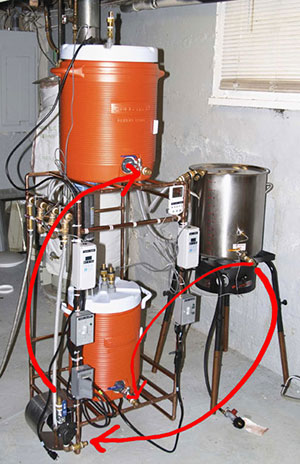
A Quick Overview:
It takes good ingredients to make good beer.
First you must start with quality malt. Malt is Barley that has been germinated and then dried. This process loosens up the starches in the barley and makes available enzymes that we are going to use in the brew house. The whole process of making beer is about converting the starches in the barley into simple sugars, and then feeding those sugars to yeast who 'burn' them to create alcohol and CO2.
There are many different types of malt. Our 2-row malt is dried quickly and at low temperatures to provide a light base malt. We also use a Munich malt that is dried at higher temperatures. The high temperature drying process allows a better formation of melanoid flavor compounds. The higher the temperatures, the more intense the flavors. Very high temperatures can lead to burnt flavors, like many of the malts used in Stouts and Porters. Other malts are roasted wet. This causes various carmalizations (like Malliard reactions) to happen during the malting process. We use a dark caramel malt that is very important in the making of our Schild Brau Amber.
Hops are the flower of the hop vine. This vine is very closely related to the Cannabis, Nightshade, and Tomato family's of vine. The flowers are green and contain lupelin glands, that contain the essential oils that we need to flavor our beers. Hops provide the bitterness of beer. They also can provide various floral, spicy, and citrus notes to beer. Hops need to be boiled to let the bitter compound dissolve into the wort. Its no coincidence that hops help keep beer from spoiling, this is something that people figured out in ancient times through trial and error.
Water is a very important ingredient in beer. However, its not something that a brewer can do much about. When you have hard water, its best to make beer styles that go well with hard water. Hard water is a good match for bitter ales, stouts, and full bodies lagers like Bock and Marzen. Soft water tends to reduce the perceived bitterness in beer. Hard water emphasizes body and maltiness in beer.
Yeast are the workhorses of beer production. These are little single celled animals (they are actually classified as fungi, though they really are more similar to animals) . They take the sugars in the wort and consume them in a way similar to how you and I do. They leave alcohol and Carbon Dioxide behind, though, because they are fermenting, not respiring, like we do (see your biology 101). The C02 bubbles away, and is our big clue to how vigorous the yeast are fermenting. They also produce plenty of by-products that add to the flavor of beer. These 'esters' are very unique to each different strain of yeast. There are literally hundreds of different strains of yeast, each with their own flavor profile. So the choice of yeast has big impact on the final flavor of a beer.
Brew Days start at 8am. First we fill up the Mash Tun vessel with hot water. When we have it half full, we start the mill and begin mashing in. The malt is dumped into the mill and into a chute that sends it into the mash tun below.
The type of crush is very important. If it the malt is too finely crushed, we will have problems with dust later on. If we do not crush it enough, we will not get all of the possible sugars out of the malt. Ideally the malt will be just cracked open, so that the endosperm is exposed, and the husks are intact and available for use in the next step.
We hold the mash at 155 degrees until all of the starch has been 'magically' converted into sugar by the enzymes naturally present in the malt. This usually takes an hour and a half or so. On some beers we will do multiple steps to use different types of enzymes, such as proteases and betaglucanase.
When it is ready, we move the mash over into the Lauter Tun vessel. This vessel has a false bottom or screen in it that holds back the grains. We slowly run the liquid off the mash into the Grant, which acts like a buffer zone so we don't get suction on the bed. This liquid is now called Wort, a German word for un-fermented beer.
By circulating the wort back up to the top of the lauter tun, the husks of the barley will rest on the screen and form a filter bed. This clarifies the wort, making it run clear. When it is clear, we start running off the wort into the boiling kettle. We add hot water to the top of the grain bed to fully extract all of the sugars out of the mash. We keep doing this until the Kettle is full.
When we are done, we have to drain the Mash Tun, and shovel the spent grains on to the compost pile.
When the kettle is full, the wort is then brought to a boil. We boil the wort for a full hour or longer. At certain times during the boil, we add hops to the wort. It is essential that hops be boiled in order for their bitterness to be perceived. Some hops, called finishing hops are added later in the boil for aroma and flavor. The boiling also sterilizes the wort and breaks down large proteins which settle out to the bottom. We measure the success of our boil by the amount of evaporation. A high evaporation rate is good, because you are removing off flavors like DMS that can form in the intense heat of the boil.
the wort is transferred over to the Whirlpool Vessel. This tank has a tangential entry, which gives the incoming wort a spin. This makes the hops and protein sediment go to the center, just like how when you stir up a cup of tea, the tea leaves will go to the center.
After the boil is complete, it id cooled using an immersion Heat Exchanger. This cools the wort by passing over many plates that have cold water on the other side. We cool our wort down to 55 degrees, which is an appropriate temperature for lager fermentation.
After going through the Heat Exchanger, the wort is moved into a freshly cleaned Fermentation Tank. Here also we inject the yeast. We also add a tiny bit of oxygen that yeast need to grow and divide before they begin their fermentation.
Fermentation begins within 12 to 24 hours after the yeast is pitched into the fermenter. This initial lag phase is when the yeast grow and divide. Each yeast cell will produce two to three new cells. Once all of the oxygen is used up, they stop dividing, and start to ferment. This starts slow, as small bubbles in the bucket next to the fermenter. In a few hours, though, it really starts going.
Lager yeast like to ferment at about 55 degrees F. Initial fermentation will last 3-5 days. We let our brews sit in the fermenter for a full seven days to be sure that fermentation is complete. Then we cool the beer to help the yeast settle down to the bottom of the tank.
When the beer has been under active cooling for several days, we transfer the beer into a tank in our cold Lagering fridge. This beer is called Green Beer because it still needs to mature. The fermentation by the yeast was hasty, and they have left many undesirable byproducts behind, such as sulfur. Many yeast are still in suspension, and they continue to mature the beer. We prefer to leave the beer in this phase for at least two weeks, though beer can stay in the lager stage nearly indefinitely.
After the beer has been transferred to the Cellar, the yeast are harvested from the fermenter. Yeast flocculate to the bottom of the fermenter when all of the sugars have been eaten and turned into alcohol. I need to harvest this yeast, and check its viability, for use in the making the next batch of beer. We re-use our lager yeast many times.
To harvest I simply reach inside with stainless steel loop and transfer the yeast into glass containers. The yeast is then kept on ice until it is needed.
The beer is now finished, and can be packaged in either bottles or kegs.